CPTC Annual Conference
CPTC Annual Conference 2026
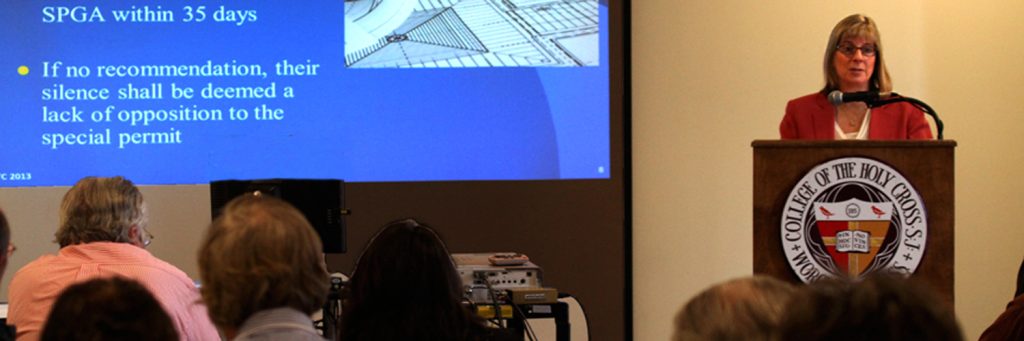
The 22nd CPTC Annual Conference will be held on March 21, 2026 at Holy Cross College was a big success. Thank you everyone who participated especially the speakers and moderators who donate their time and expertise. Thank you our sponsors who help make the conference possible.
8:00 a.m.-8:30 a.m. Registration and Continental Breakfast
8:30 a.m. – 9:00 a.m. General Opening/Welcome and Keynote Speaker: Chris Kluchman, FAICP, Undersecretary, Livable Communities Division, Executive Office of Housing and Livable Communities (EOHLC)
9:15 a.m. -10:45 a.m. Early Morning Sessions
1. Roles and Responsibilities of Planning and Zoning Boards – (MIIA)
Join us if you are a new Board member or building inspector. This program will launch you into your role as a local official and introduce you to the functions of the two boards and the main tools of planning and zoning. This session will also include an introductory discussion of the Open Meeting, Public Records, and the Conflict-of-Interest Laws.
2. Reasonable and Defensible Decisions – (MIIA)
This course covers some key points that will assist boards in making clear and defensible decisions and why that is important. It describes criteria that should be contained in local zoning provisions and how they relate to the drafting of the decision and the conditions a board may impose when approving a special permit or variance application. The first part of this course covers legal and procedural requirements for conducting a public hearing and the ramifications of failure to follow procedural regulations in the decision-making process.
Speaker: Barbara Saint André, Esq., Director, Community and Economic Development, Town of Medway
3. Working with MGL Chapter 40B – (MIIA), CM / 1.5
A workshop for municipal staff and local boards reviewing applications for projects seeking a comprehensive permit under G.L Chapter 40B. Topics will include the following: reviewing the initial application for completeness and compliance with state and local requirements; conducting a site visit; managing the public hearing process; retaining Peer Review consultants; making an informed decision consistent with the local needs provided for in the statute; drafting and issuing the Comprehensive Permit decision; and working with developers, abutters, and other interested parties. This workshop will focus on how municipal officials as well as others can use 40B to achieve housing goals as well as some of the permitting requirements involved with 40B.
Speaker: Judi Barrett, Owner & Managing Director, Barrett Planning Group LLC
4. State Land for Homes Initiative: What Cities and Towns Should Know – CM / 1.5
Massachusetts Division of Capital Asset Management and Maintenance (DCAMM) and Executive Office of Housing and Livable Communities (EOHLC) will present on the State Land for Homes Initiative, which implements authorization in the 2024 Affordable Homes Act (AHA) to dispose of state land for housing development. Speakers will discuss several current projects and review requirements relating to local permitting of land sold under the AHA.
Speakers: Chris Kluchman, FAICP, Undersecretary Livable Communities Division, Executive Office of Housing and Livable Communities (EOHLC); Abigail (Abi) Vladeck, AICP, Deputy Commissioner for Real Estate, Massachusetts Division of Capital Asset Management and Maintenance (DCAMM)
5. Climate Resilience Playbook: Advancing MA Communities’ Climate Action – CM / 1.5
The Climate Resilience Playbook is an online interactive tool designed to help Massachusetts cities and towns advance their climate resilience planning and project implementation. By providing guidance and ideas for projects that advance inclusive and equitable climate solutions (many of which have been piloted or implemented successfully), the Playbook helps to address the growing need for additional capacity building and technical assistance as local governments and community partners lead on local climate action. Metropolitan Area Planning Council (MAPC) Project Team will provide an overview of the playbook and tips on how your community can use this new planning tool.
Speakers: Emma Zehner, Senior Clean Energy and Climate Planner, MAPC; Laura Bandara, Deputy Director, Land Use and Environment, Pioneer Valley Planning Commission (PVPC)
6. Micromobility: Prospects for Safety Regulations and Promotion – CM / 1.5
Use of micromobility devices—ebikes, mopeds, uniwheels, scooters, etc.—is growing fast. While Micromobility devices offer expanded access and freedom, they also raise new and significant safety concerns, especially on paths, sidewalks and bike lanes, and regulations and rules governing their use have lagged. The Massachusetts Legislature, at the request of Consulting Planners of Massachusetts, called for a Special Commission on Micromobility to be convened to explore how devices are categorized, analyze current rules around them, and to develop recommendations for new and improved rules and regulations. The Commission’s work concluded in December. This session will review the Commission’s recommendations, focusing on those dealing with speed restrictions, where the devices can be ridden, and device registration. The panelists will highlight recommendations that can be tailored to the differing needs of individual communities and will lead attendees in a discussion of ways to most safely maximize micromobility.
Speakers: Leonardi Aray, Principal, Leonardi Aray Architects; Craig Kelley, Municipal Issues expert, Urban Core Strategies; Anne McKinnon, Planner, Leonardi Aray Architects; Jeffrey Ferris, founder and former owner of Ferris Wheels Bike Shop
11:00 a.m. -12:30 p.m. Late Morning Sessions
7. Introduction to the Zoning Act – (MIIA)
This course addresses the purposes of the Zoning Act and the process (and the Planning Board’s role) for the adoption/amending of zoning bylaws and ordinances. The difference between variances and special permits will be discussed. Additionally, the course will include how zoning is enforced and by whom as well as the role of the Zoning Board of Appeals in variances and zoning appeals.
Speaker: Adam J. Costa, Attorney, Mead, Talerman & Costa, LLC
8. Who Wants to be a Zoning Expert? – (MIIA), CM / 1.5
Join our panelists as they compete for a secret prize that will be awarded to the most authoritative (and least flappable!) contender in Who Wants to be a Zoning Expert? Modeled after a recent community engagement skit for East Longmeadow’s zoning update, this session will cover all things zoning, from the basics to the esoteric and some topics that remain untested and unsettled today. Our game show host, Barbara Saint André, will lead the program and do her best to keep panelists in line. Audience members may be called upon to help the panelists with tough questions, similar to the “lifelines” used in the real “Who Wants to Be a Millionaire” game show.
Speakers: Judi Barrett, Owner & Managing Director, Barrett Planning Group LLC; Barbara Saint André, Esq., Director, Community and Economic Development, Town of Medway; Emily Innes, AICP, LEED AP ND, President, Innes Land Strategies Group, Inc.; Lee Hartmann, Senior Planner, Merrill; Barney Heath, Executive Director, MetroWest Collaborative Development
9.Getting Locally Permitted Affordable Units Onto the Subsidized Housing Inventory – CM / 1.5
Did your municipality just pass inclusionary zoning or designate a parcel of land to be developed with affordable housing? Has your Planning Board or Zoning Board of Appeals just permitted affordable housing units in a development? Want those affordable units to count on your municipality’s Subsided Housing Inventory? Join this session to find out how to count those units!
Speakers: Alexis Lanzillotta, AICP, Principal Planner, Barrett Planning Group LLC; Aly Sabatino, LIP/HOP Coordinator, Executive Office of Housing and Livable Communities (EOHLC)
10. New Local Permitting for Clean Energy Projects – What You Need to Know – CM / 1.5
The 2024 Climate Law establishes new expedited permitting for small and large clean energy infrastructure projects. Planning Boards, Zoning Boards of Appeal, and other local permitting authorities will review small projects – up to 25 MW of solar or 100 MWH of battery storage – and will issue one consolidated permit rather than separate local permits. The Department of Energy Resources (DOER) is finalizing regulations for this new process, including guidelines and new model solar and storage zoning bylaws. The workshop will explain the new rules, walk participants through the process, and lead a conversation about what’s next.
Speaker: Rick Collins, Director, Clean Energy Siting & Permitting Division, Massachusetts Department of Energy Resources (DOER); Stephen Meno, Ed.D., AICP, Clean Energy Siting and Permitting Regional Coordinator – Central Region, Massachusetts Department of Energy Resources
Moderator: Heidi Ricci, Director of Policy and Advocacy, Mass Audubon, CPTC Board member
11. Flood-Ready Regulations: Mastering the MA Model Floodplain Bylaw – CM / 1.5
Is your community’s floodplain zoning current? This session provides a comprehensive roadmap for navigating the latest Massachusetts Model Floodplain Bylaw. We will share tools to align your local floodplain regulations with National Flood Insurance Program (NFIP) requirements to ensure both compliance and community safety. Beyond the policy, a local planner will share a “boots-on-the-ground” case study, detailing their recent experience adopting new FEMA maps and successfully updating local regulations.
Speakers: Nadia Madden, Floodplain Management Specialist, Flood Hazard Management Program, MA Department of Conservation and Recreation; Maren Toohill, AICP, Town Planner, Town of Littleton, CPTC Board member
12. Design-Led Zoning: Achieving Community Vision Through Form-Based Code – CM / 1.5
An introduction to Form-Based Code, including how it differs from traditional Euclidean zoning, the basics of different design controls, the implications for municipal review, and Utile’s unique approach to FBCs we call “Form-Based Code Lite”. The session will review FBCs in Littleton (2020) and Orleans (2025), covering their unique guiding design principles, mapping strategies, and the Town’s perspective on guiding and passing local zoning reform (for Orleans).
Speakers: Jessy Yang, Senior Architectural and Urban Designer, Utile; Loren Rapport, Senior Architectural and Urban Designer, Utile; Courtney McCracken, Architectural and Urban Designer, Utile; Elizabeth Jenkins, Assistant Director of Planning & Community Development, Town of Orleans
12:30 p.m. – 1:15 p.m. Lunch – Networking
1:30 p.m. – 3:00 p.m. Afternoon Sessions
13. Managing Challenging Meetings: Strategies for Conflict-Resilient Planning – (MIIA), CM / 1.5
Join MAPC’s Community Engagement team for an interactive training focused on handling tense or high-stakes meetings. Learn how to create non-traditional agendas that set the stage for more productive dialogue and develop practical skills to de-escalate situations, helping conflict become more generative and meetings more collaborative. Legal strategies will be discussed to ensure that your meeting does not run afoul of applicable laws.
Speakers: Javier Gutierrez, Director of Community Engagement, Metropolitan Area Planning Council (MAPC); Colette Lima, Community Engagement Specialist, MAPC; Pam Brown, FAICP, Partner, Brown & Brown, P.C.
14. Special Permits and Variances – (MIIA), CM / 1.5
Participants will learn about the difference between special permits and variances, the issues and criteria for decision-making, and procedural requirements. Additionally, the course will discuss who has the authority to issue special permits and variances and how judicial decisions guide the way we work with them.
Speaker: Brian Currie, AICP, Consultant
15. Measuring Economic Benefits of Complete Streets – CM / 1.5
Understand the community economic benefits of complete streets design and construction investment. Nationally, performance measures and metrics have shown that incorporating complete streets practices into roadway design improves roadway safety for all users. The case has been made that construction of complete streets also has benefits for public health, economic viability, and quality of life in the neighborhoods where they are implemented. Massachusetts Department of Transportation (MassDOT) developed a methodology for quantifying and measuring these indirect impacts via Massachusetts case studies, from the communities of Cambridge, Fitchburg, Lenox, Northampton, Salem, and Somerville. Nationally, there is an increased focus on the safety of vulnerable road users, such as people walking, rolling, and biking. By quantifying the economic impact of active transportation projects, communities can better understand the long-term impacts and return on investment for Complete Street projects.
Speakers: Juliet Walker, AICP, Principal Planner, Kittelson & Associates, Inc.; Madeline DeClerck, PE, Supervising Project Manager, Highway Division, Massachusetts Department of Transportation; Ann Ormsbee, Senior Economist, Cambridge Econometrics
16. What’s New in Your Community? – A Roundtable Discussion – CM / 1.5
Bring your planning and zoning questions, challenges, and novel ideas! Margaret, Judi, and Maren will lead a roundtable discussion with technical assistance, guidance, a little “planners therapy”, and perhaps a helpful perspective on how your community can approach pressing land use issues.
Speakers: Margaret Hurley, Senior Counsel for Housing and Municipal Law, Municipal Law Unit, Massachusetts Office of the Attorney General; Judi Barrett, Owner & Managing Director, Barrett Planning Group LLC; Maren Toohill, AICP, Town Planner, Town of Littleton, CPTC Board member
17. Getting the Housing We Need (in the locations we want): Understanding and Addressing Regulatory and Infrastructure Challenges CM / 1.5
In recent years cities and towns across the state have stepped up to support the state’s housing goals by adopting new zoning districts intended to meet the housing needs of ALL members of their community. In some cases, new multi-family development is already proposed or underway, yet significant challenges prevent communities from getting the housing that they need. Speakers will draw on specific case studies and on-the-ground data to illustrate remaining regulatory and infrastructure challenges, and explore possible solutions.
Speakers: Tom Hopper, Director, Center for Housing Data, Massachusetts Housing Partnership; Amy Dain, Senior Fellow, Boston Indicators
Moderator: Katharine Lacy, AICP, Senior Planner, Massachusetts Housing Partnership, CPTC Board member
18. How NOT to Work with a Consultant CM / 1.5
Is your community considering a new planning process? Have you or your Planning Board worked with a planning consultant before? Join us to discuss the best ways to ensure your relationship with the consultant team starts out on the right foot. We will discuss the messages RFPs send to prospective respondents, the consultant’s role in the planning process, and tips for building a strong relationship that leads to a successful, enjoyable experience for you, your community, and the consultant. The panel will include both consultants and municipal planners.
Speakers: Eric Halvorsen, Vice President, RKG Associates; Erika Jerram, Director of Community Development, City of Watertown; Emily Innes, AICP, LEED AP ND, President, Innes Land Strategies Group, Inc.
Conference Policies & Location
- Location: Holy Cross College, Hogan Conference Center, 1 College Rd., Worcester MA (use Upper Campus Rd to access the Hogan Center).
- The 2026 CPTC Annual Conference is an in-person event. Workshops will not be recorded.
- Continental breakfast and buffet lunch are included. Please contact coordinator@masscptc.org by Friday, March 13th with any dietary restrictions.
- Payment is available by check or credit card (cc payment is only available online at the time of registration). Checks can arrive after the registration deadline. Please make checks payable to CPTC and mail to: Citizen Planner Training Collaborative (CPTC), c/o Urban Harbors Institute, University of Massachusetts Boston, 100 Morrissey Boulevard, Boston, MA 02125.
- Cancelation Policy: Registering for the conference is a commitment to attend. Payment is required unless a written cancelation request is received by the CPTC Coordinator at coordinator@masscptc.org by Friday, March 13, 2026 at 5:00 p.m. No refunds will be processed after that date.
- Please contact coordinator@masscptc.org with any questions.
Disclaimer
The use of the facilities of the College of the Holy Cross for this event does not constitute an endorsement by the College. The College of the Holy Cross does not endorse any candidate, or organization, in connection with this or any other political campaign or election.